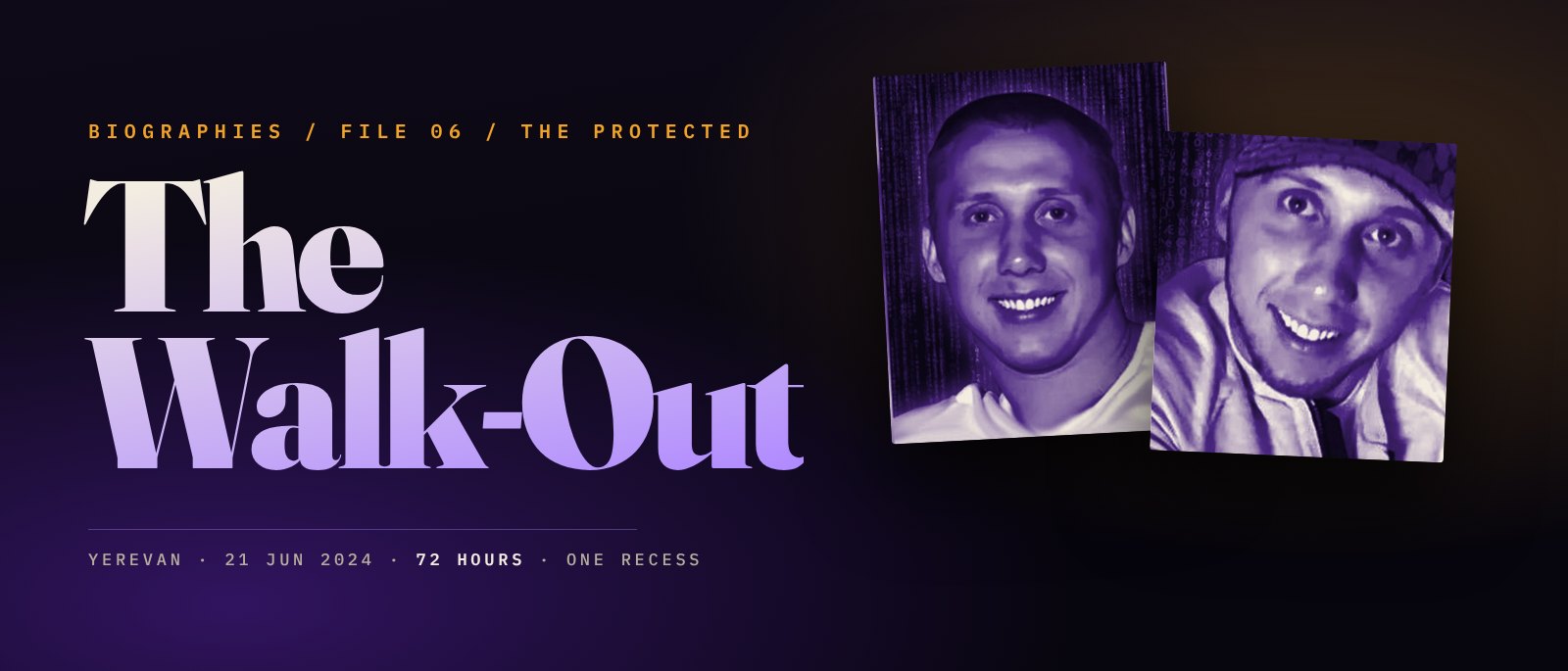
 Cover · the two photographs on the German wanted notice
The Walk-Out: Oleg Nefedov, Tramp
Armenia arrested the head of Black Basta on an American warrant, held him for the seventy-two hours its law allows, and watched him walk out of the courtroom during a fifteen-minute recess. Nineteen days later his companies began changing hands. This is the one file where the protection left paperwork.
Open the file →
Indifference as a Service
Every ransomware crew, every stealer panel, every leak site needs a server that will not be switched off when someone complains. There is an industry for that. It has many names, one product, and, for the crews that matter most, a roof.

The Roof Has Windows
The Russian state does not just shelter its ransomware crews. It watches them: formally, comprehensively, without a court order. Once you see the surveillance, tolerance stops being a plausible story.
The Bloodline
Every major Russian ransomware brand since 2007 descends from a small circle of men who knew each other before 2014. Track the people and the chaos resolves into a family tree. Seven parts. Named, sourced, and graded.
Indifference as a Service
What a bulletproof host actually sells, why the ecosystem cannot run without it, and why the roof needs the metal. The Metal, Part 1. 13 Oct 2026 · 14 minThe Roof Has Windows
SORM, Rosfinmonitoring, the Central Bank, the tax service: total visibility, and what it proves about protection. 31 Jul 2026 · 15 minThe Long Cash-Out: how a ransom becomes rubles
The seven moves that turn a payment into spendable money, and where the chain is thinnest. 9 Jul 2026 · 19 minOperation Endgame: the layer it cannot reach
What the best disruption operation in Europe achieved, and the one dependency it left standing. 19 Jun 2026 · 10 minAfter Garantex: where the cash-out moved next
Three brand changes, one unmoved settlement layer. 18 Jun 2026 · 11 minSeries parts are listed once, in The Bloodline above.
End Krysha is an independent threat intelligence publication, the public face of a longer research program: mapping the dependencies that keep Russia and CIS ransomware operations alive, and identifying the pressure points where targeted enforcement produces measurable degradation. Every dispatch is sourced and carries analytic confidence labels.
Groups rebrand. Dependencies don't. Ransomware doesn't run on malware; it runs on a krysha: the roof the Russian state holds over its crews while the money moves and the servers stay up. We find the roof, we document how it works, and we map where it is weakest.